General information for everyday care. This guide has not been reviewed by a veterinarian and does not replace advice from your veterinary team.
Why there is no single dog feeding chart for every dog
Two dogs with the same body weight can need different amounts of energy. Age, activity, reproductive status, health, environment and the calorie density of the food all affect the answer. A cup of one kibble may contain a different number of calories from a cup of another, so copying a neighbour’s scoop is not a reliable method.
A useful feeding guide gives you a starting point and a way to review it. It should not promise that every dog of a certain weight needs exactly the same bowl.
Step 1: choose a complete food for the right life stage
Use a food labelled as complete and balanced for your dog’s life stage and follow any veterinary diet prescribed for a health condition. Puppies, adults, seniors, pregnant dogs and working dogs can have different requirements. If the label is unclear or you are considering a homemade or highly restricted diet, speak with a veterinarian or qualified veterinary nutrition professional.
Do not add vitamin or mineral supplements to a complete diet unless a veterinarian recommends them. More is not automatically better, and unnecessary supplements can unbalance the diet.
Step 2: read the daily amount on the label
Find the feeding guide and confirm whether it lists the total amount per day or the amount per meal. Start in the range that best matches your dog, then divide the daily total across the number of meals you feed. If you mix wet and dry foods, each part contributes to the same daily total.
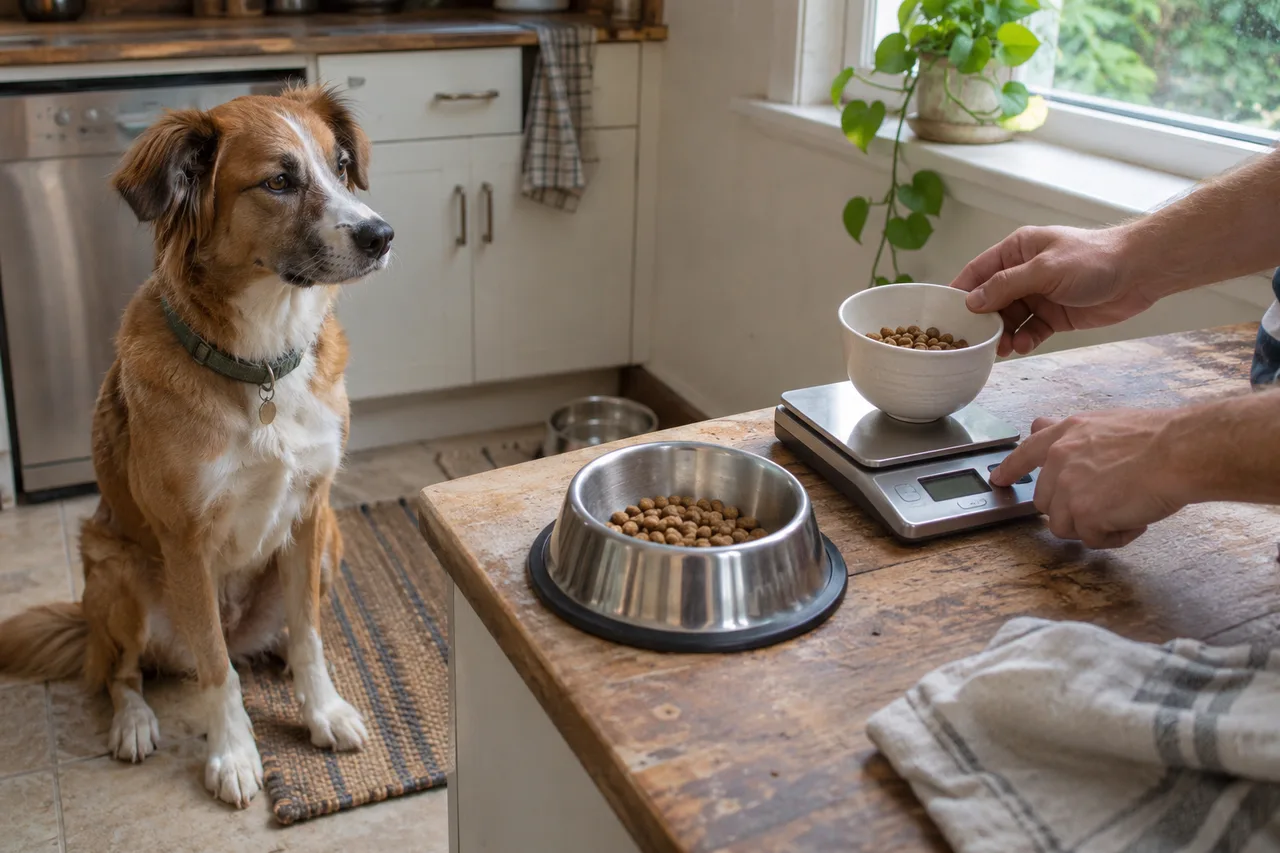
A kitchen scale is often more consistent than a household cup. Weighing also makes it easier to adjust the amount in small steps and tell another family member exactly what has already been fed.
Step 3: count treats, toppers and shared food
Training rewards, dental chews, table scraps and food used in enrichment all count. Set aside part of the dog’s daily food for training or search games, or reduce the meal portion to allow for extras. Agree on a household plan so several people do not each assume they are giving the only treat of the day.
Treats should remain a small part of the overall diet. Their value is in timing, not size: tiny pieces can still reward behaviour effectively.
Step 4: review body condition and weight
The label cannot see your dog. Review weight and body condition over time, and ask your veterinary team to show you what an appropriate body condition looks and feels like. Adjustments should be measured and reviewed rather than made from one unusually active or quiet day.
Seek veterinary advice if weight changes without an obvious reason, if your dog is persistently very hungry, or if appetite or thirst changes. Puppies and dogs with medical conditions need individual guidance rather than an internet calculation alone.
How often should I feed my dog?
Meal frequency depends on age, health and household routine. Puppies generally need more frequent meals than adults. Many adult dogs are fed in two measured meals, but your veterinarian can advise what suits your dog. The important point is to divide the daily allowance rather than repeating the whole allowance at every meal.
Where Holdable fits
Feeding is one of the small rituals that shapes life with a dog: the sound of the bowl, the waiting place and the expression that appears at exactly the right time. A custom Holdable character can preserve those familiar details through posture, props or a story-led outfit, while the face remains grounded in the dog’s real photos.
Frequently asked questions
How many cups of food should I feed my dog?
Use the daily amount on the specific food label as a starting point because calorie density differs between foods. A kitchen scale is more consistent than a cup, and the amount should be reviewed against body condition and veterinary advice.
Should I feed my dog once or twice a day?
Meal frequency depends on age and health. Many adult dogs eat two measured meals, while puppies usually need more frequent feeding. Ask your veterinarian for individual advice.
Do dog treats count as part of the daily food amount?
Yes. Treats, chews, toppers and food used for training or enrichment all contribute to the daily total.
Should I change the amount when I change dog food?
Yes. Different foods contain different calories per gram or cup. Follow the new label, transition as directed and monitor your dog rather than keeping the old scoop automatically.
Can Holdable include a food-related detail in a custom pet character?
Yes. A familiar bowl, favourite treat ritual or waiting posture can inform the character story, provided the detail is practical at the chosen product scale.