
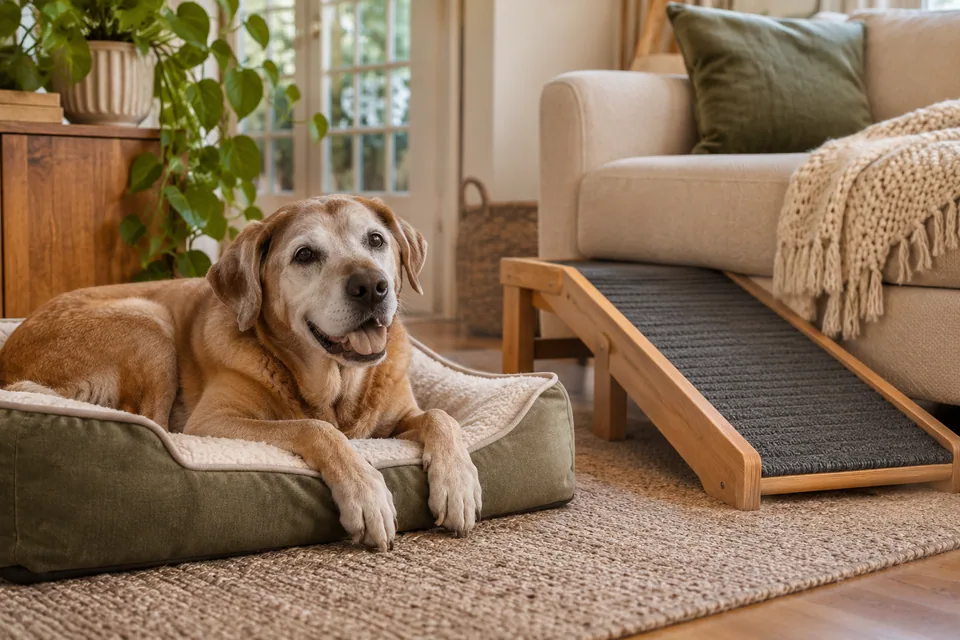
Support a senior dog with comfortable rest, non-slip routes, easy access to essentials and activity adapted with veterinary advice. Record changes in movement, appetite and behaviour, and seek assessment instead of assuming new difficulties are simply old age.
In this guide
General care and training information. This article has not been reviewed by a veterinarian and does not replace an individual veterinary or behaviour assessment.
The familiar route from bed to water bowl can become a different journey as a dog grows older. A slippery corner, a tall step or a busy doorway may matter more than a new accessory. Start with what your dog is finding difficult today.
This is a guide to home comfort and observation, not a treatment plan. Changes in movement, sleep, appetite or social behaviour need veterinary assessment; they should not be dismissed as unavoidable ageing.
Walk the home at your dog’s pace
Follow the routes your dog actually uses. Notice where they hesitate, slip, turn back or wait for help. Check the journey after dark as well as in daylight. A bowl that is technically accessible may still require crossing a polished floor the dog now avoids.
Make a short list of obstacles and address the simplest ones first. Secure non-slip runners, remove clutter and keep familiar routes predictable. Check that rugs cannot bunch up or slide. The RSPCA’s senior-dog advice highlights adapting comfort and access to the individual.
Put rest where it can be used
Offer a supportive bed with an easy entrance in a quiet location. Consider temperature, draughts, household traffic and the dog’s preference for being near people. Some dogs want a calm corner in the living room as well as a separate retreat.
Do not require a jump to reach the only comfortable sleeping place. If a ramp or step is appropriate, it must be stable, suitable for the dog and introduced gradually. Ask the veterinary team about safe assistance if your dog is struggling to stand, climb or be lifted.
Protect access to food, water and toileting
Keep essentials within a manageable route. In a multi-dog home, check that a younger or more active pet is not reaching food first or blocking the older dog’s way. Feed separately if that provides more comfortable access.
Review toilet opportunities with the dog’s current abilities in mind. A long trip down steps may require a different routine or an accessible alternative planned with your veterinary team. Do not restrict water to reduce accidents, and do not punish a dog for a change that may have a medical cause.
Adapt activity with professional advice
Older does not automatically mean inactive. Ask your veterinarian what movement is suitable for this dog, then build it into the day at a manageable pace. Shorter, more comfortable outings may be preferable to one ambitious walk, depending on the individual.
Include low-pressure interest: a familiar scent route, a simple food search using part of the daily allowance, or a quiet shared moment outdoors in suitable weather. Avoid forcing participation when the dog is tired or uncomfortable. RSPCA Queensland’s senior-pet guidance discusses practical home adaptations and enrichment.
Keep a factual comfort record
| Area | Useful observation to share with your vet |
|---|---|
| Movement | Where slipping or hesitation occurs; changes in rising |
| Appetite and drinking | What changed and when, rather than simply good or bad |
| Rest | New difficulty settling, repeated waking or a different sleeping place |
| Toileting | New accidents, altered frequency or signs of discomfort |
| Social behaviour | Avoiding touch, withdrawing or reacting differently to familiar activity |
A short video of normal movement may help your veterinarian if it can be recorded without making the dog repeat a painful task. Do not deliberately provoke symptoms for a better clip. Keep medication information and questions together for the appointment.
Know what home changes cannot solve
New stiffness, reluctance to be touched, repeated pacing or unusual irritability can have more than one cause. Arrange an assessment rather than choosing supplements or pain medication yourself. Never give human pain relief unless your veterinarian specifically directs it for that dog.
Collapse, difficulty breathing, inability to urinate, major trauma or severe acute distress need immediate veterinary care. Cornell’s emergency guidance lists examples of urgent conditions. A comfortable bed is supportive care, not a reason to delay treatment.
Keep the relationship familiar
Adapt the activities you share without making every interaction a health check. A gentle brush if welcomed, a brief sniff outside or simply resting near you can still be part of the day. Ask visitors and children to let the dog sleep and choose when to engage.
Review your daily dog care routine and use our home grooming guide for gentle, limited tasks. Record the ordinary habits you love in a pet memory journal, while keeping medical decisions with your veterinary team.
Frequently asked questions
Is slowing down always normal for an older dog?
Do not assume so. New or persistent changes in movement or behaviour deserve veterinary assessment, even when they develop gradually.
What is the easiest home change to start with?
Review the route to water, food, bed and the toilet area. Secure non-slip footing and remove avoidable obstacles where your dog is struggling.
Should a senior dog stop going for walks?
Not automatically. Ask your veterinarian what activity is suitable and adapt pace, route and duration to the individual.
Can I give human painkillers for stiffness?
Do not give human medication unless your veterinarian specifically directs it for that dog. Arrange an assessment and an appropriate treatment plan.
Does an older dog need a completely new routine?
Often small adaptations to a familiar rhythm are more practical. Keep useful predictability while changing access and activity to suit current needs.
Sources
Care principles were checked against these resources on 14 November 2026. The organisations listed have not reviewed or endorsed this article.