
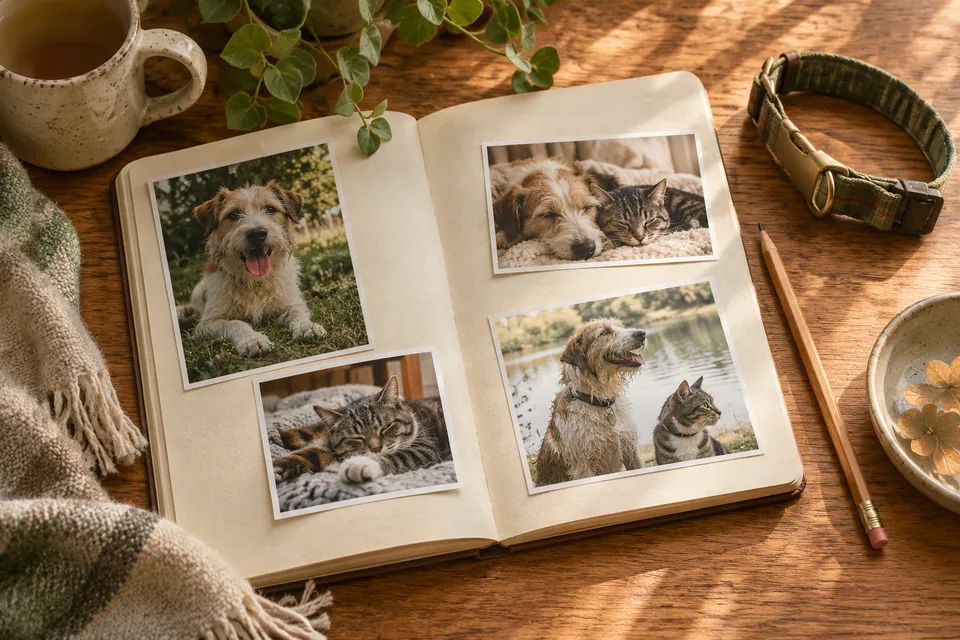
Start a pet memory journal with one ordinary photo, a date and a few lines about a habit you recognise. Add small observations regularly rather than waiting for milestones. Keep original files backed up and choose which memories remain private.
In this guide
Editorial prompts for personal storytelling. Keep private information out of pages you share publicly.
The pet photographs we return to are not always the polished ones. Sometimes it is the crooked sleeping position, the face waiting at a familiar door or the blur of a favourite toy being carried away. A memory journal gives those images the missing sentence: this is what an ordinary day with them felt like.
You do not need a beautiful notebook, a perfect camera or a dramatic story. Start with a record small enough that you will actually keep it. These prompts are an editorial activity, not a therapy programme or a promise about how anyone should feel.
Choose a format that fits your habits
If you already take notes on your phone, start there. If printing photographs makes you slow down and enjoy them, a paper notebook may be more satisfying. A shared family document works when several people notice different parts of the same pet’s day.
Keep the first version simple: a date, a photo or short description, and a few lines. You can always make an album later. Waiting to choose the perfect layout often means the ordinary details stay scattered across camera rolls and message threads.
Make your first entry about something small
Choose a moment from today rather than writing the entire story of your pet’s life. Where did they settle while you worked? What sound brought them into the room? Which toy did they choose when several were available?
Describe what you saw before adding what it meant to you. For example: she placed one paw on the blanket before lying down, followed by that little pause always makes this spot feel like hers. Observation and interpretation can sit together without being confused.
Ten prompts for ordinary days
- The place they choose when the house becomes quiet.
- The greeting you recognise before you see their face.
- A tiny habit somebody outside the family might miss.
- The toy, blanket or safe object they keep returning to.
- A walk, window view or resting spot that belongs to your shared routine.
- A face marking, ear shape or posture you would recognise anywhere.
- The way a routine changed as they grew more confident.
- A small success you practised together without rushing.
- A sound, nickname or household phrase with a story behind it.
- One moment you would keep even if nobody else understood why.
Use one prompt at a time. The journal does not need a new milestone every week. A repeated habit can be worth recording precisely because it is familiar.
Take photos without making the pet perform
Work with available light and an activity the pet has already chosen. Take a wider image showing the place, then a closer image if they remain comfortable. Avoid flash near the face, forcing a pose or moving an animal into an unsafe setting for a better background.
With rabbits and other small pets, stay at floor level and protect their retreat. With cats, let them leave. With dogs, a resting moment can tell as much as an elaborate trick. Clear photos can be useful, but comfort matters more than a sharp shot.
For images intended for an artwork commission, our pet photo reference guide explains the practical views an artist may need. Your journal adds something different: the context behind the expression.
A reusable entry you can copy
| Field | What to write |
|---|---|
| Date and place | A useful anchor, without a public home address |
| What happened | Two or three factual sentences |
| The familiar detail | A posture, marking, sound or choice |
| Why I want to keep it | Your own response, in your own words |
| Image or object | File name, print or description of a keepsake |
Keep health notes in a separate practical record that you can share with the veterinary team. A memory entry can mention a change, but it should not turn a meaningful observation into an unverified diagnosis.
Save the originals and protect private details
Keep original photographs as well as edited copies. Use folders or album names that you can understand later, and maintain a backup in a location you trust. A favourite image pasted into a messaging app may not retain the quality needed for printing.
Before sharing pages publicly, check for address labels, phone numbers, school uniforms, veterinary paperwork and other people in the background. Ask permission before sharing someone else’s words or photograph. You can publish a small selection while keeping the full journal personal.
Let the record guide a meaningful keepsake
If you later commission a custom pet character, the journal can help identify which details matter most. A familiar head tilt, the way one ear sits and a short story about a favourite safe activity may communicate more than a generic list of breed traits.
Choose one or two details to discuss with the artist rather than trying to fit every memory into a small object. Explore Holdable’s custom pet pieces and use the journal to explain the face and character you want to recognise. A keepsake can be one part of the record; it does not need to replace the ordinary photos and words.
Frequently asked questions
How often should I write in a pet memory journal?
Choose a rhythm you can maintain. A short entry when you notice something meaningful is enough; there is no required daily streak.
Is a memory journal only for an older pet?
No. You can begin with a new arrival, a long-established companion or memories you are gathering retrospectively.
What if I only have ordinary phone photos?
Ordinary photographs often show the most familiar expressions and settings. Keep the originals and add the story that makes each image meaningful.
Can the whole family contribute?
Yes. A shared format can reveal different observations. Agree what stays private and ask permission before sharing another person’s entry.
Can I use the journal for a custom pet portrait?
Yes. Select clear reference images and a few specific details about expression, markings and personality, then discuss what is practical for the chosen artwork.