
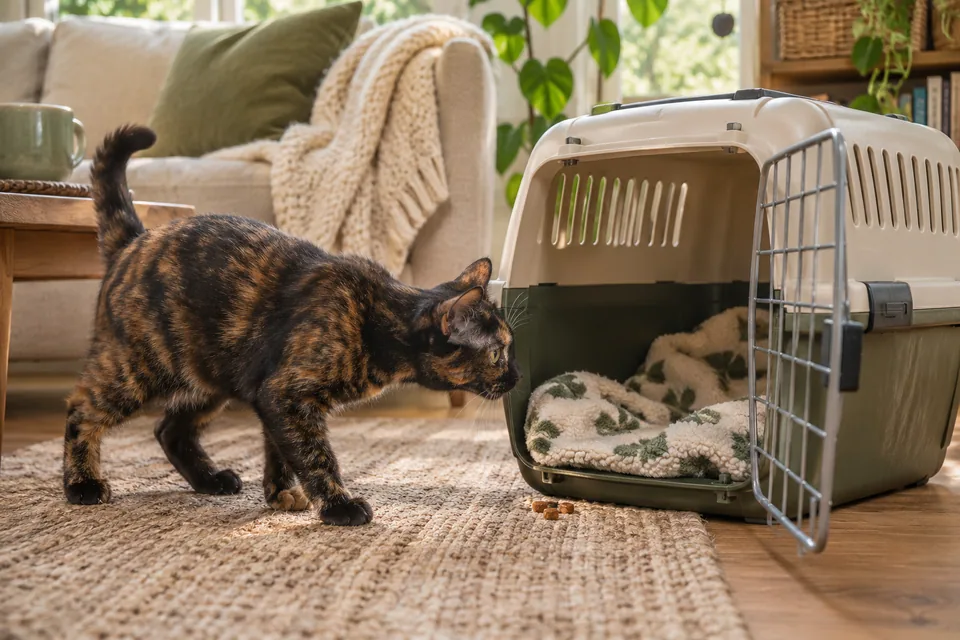
Begin cat carrier training by leaving a secure, open carrier in a quiet familiar room. Reward voluntary exploration, then separately practise comfortable time inside, brief door closure and gentle movement. Return to an easier step whenever the cat appears worried.
In this guide
General care and training information. This article has not been reviewed by a veterinarian and does not replace an individual veterinary or behaviour assessment.
A carrier that appears only before an appointment can become a warning signal. Training gives you a chance to change that association during ordinary afternoons, when there is no departure deadline and your cat can walk away.
The aim is a practical care skill, not a performance. Choosing to investigate, resting inside and remaining comfortable with a brief movement are separate achievements. Work on one at a time.
Choose equipment you can use calmly
Use a sturdy carrier with secure fastenings, adequate ventilation and enough space for your cat to stand, turn and lie comfortably. A removable top can make access easier when appropriate. Check the door, handle and base before starting; training cannot make an insecure carrier safe.
Place it on a stable floor rather than on a wobbling stool. Add familiar bedding and secure the door open so it cannot swing shut unexpectedly. Cats Protection’s carrier guide covers both carrier choice and gradual familiarisation.
Start at the distance your cat accepts
Some cats will investigate immediately. Others may only feel comfortable looking from across the room. Reward a voluntary glance or approach with something the cat values, then leave space. A reward can be a small piece of food, quiet attention or access to a familiar resting spot, depending on the cat.
Do not move the carrier closer while the cat is resting, or use food to lure them inside and then trap them. Keep training food within the daily allowance. If your cat needs a prescribed diet, ask the veterinary team what is suitable as a reward.
A progress ladder, not a seven-day challenge
| Stage | Practise | Ready to make it a little harder when… |
|---|---|---|
| Familiar object | Carrier remains open in the room | Cat behaves normally near it |
| Voluntary entry | Reward looking, approaching and entering | Cat enters without pressure and can leave |
| Comfortable pause | Reward brief relaxed time inside | Cat can remain settled with you nearby |
| Door movement | Move the door slightly, then reopen | Movement does not cause concern |
| Brief closure | Close and reopen before worry builds | Cat remains comfortable with that duration |
| Gentle transport | Lift briefly and set down steadily | Cat is comfortable before adding distance |
The rows describe increasing difficulty, not a required number of sessions. Repeat or break a stage into smaller parts. A session that ends with the cat relaxed is more useful than a longer session that ends in a struggle.
Practise the parts people often skip
Putting a hand on the handle, fastening a latch and standing up can each predict movement. Introduce these actions separately. A cat who rests happily inside may still be worried by the sound of the door or the first lift.
When lifting is comfortable, support the carrier securely and keep it level. Practise a very short carry within the home before considering a journey. Never open the carrier in an unsecured outdoor space or during car travel. Arrange safe vehicle restraint according to the carrier instructions and local requirements.
Know when to make the exercise easier
Watch for attempts to escape, freezing, crouching, repeated vocalisation or a marked change from the cat’s normal behaviour. Stop increasing difficulty. At the next session, return to a step that felt comfortable and reduce movement, duration or proximity.
Food refusal during training can be useful information, but it does not prove one specific emotion or diagnosis. If the cat is generally eating less, appears painful or remains distressed, contact your veterinarian. Do not turn the carrier exercise into a test of how hungry the cat will become.
What if the appointment is tomorrow?
Tell the clinic that carrier use is difficult and ask for a practical plan. Do not postpone necessary veterinary care in order to finish training. Your veterinary team can advise on handling and, if appropriate, prescribe support for that individual cat. Do not use human medicines or another pet’s medication.
After the visit, clean and reset the carrier as appropriate, then return it to the familiar location. Keep future practice short and ordinary. A shared household log can record the last comfortable step so the next person does not accidentally jump ahead.
Keep the skill connected to everyday care
Carrier comfort is easier to practise when the home also provides secure rest, play and predictable interaction. Use our indoor cat routine to review that wider environment. A few notes about preferred bedding and rewards can also become part of your pet memory journal, alongside the details that make your cat recognisable.
Frequently asked questions
How long does carrier training take?
It varies with the cat and their previous experiences. Use comfort at each stage as your guide rather than a promised deadline.
Should the carrier stay out between sessions?
Keeping it available in a suitable familiar place can help it become ordinary furniture rather than a signal that travel is imminent.
Should I close the door as soon as my cat enters?
No. First build comfortable voluntary entry. Introduce door movement and closure as separate, gradual steps.
What if my cat will not take treats near the carrier?
Increase distance and reduce difficulty. Use rewards appropriate for the cat, and seek veterinary advice if appetite is generally reduced or distress persists.
Can training replace help for severe travel distress?
No. Discuss significant distress with your veterinary team. Training can be part of a wider individual plan.
Sources
Care principles were checked against these resources on 14 November 2026. The organisations listed have not reviewed or endorsed this article.