
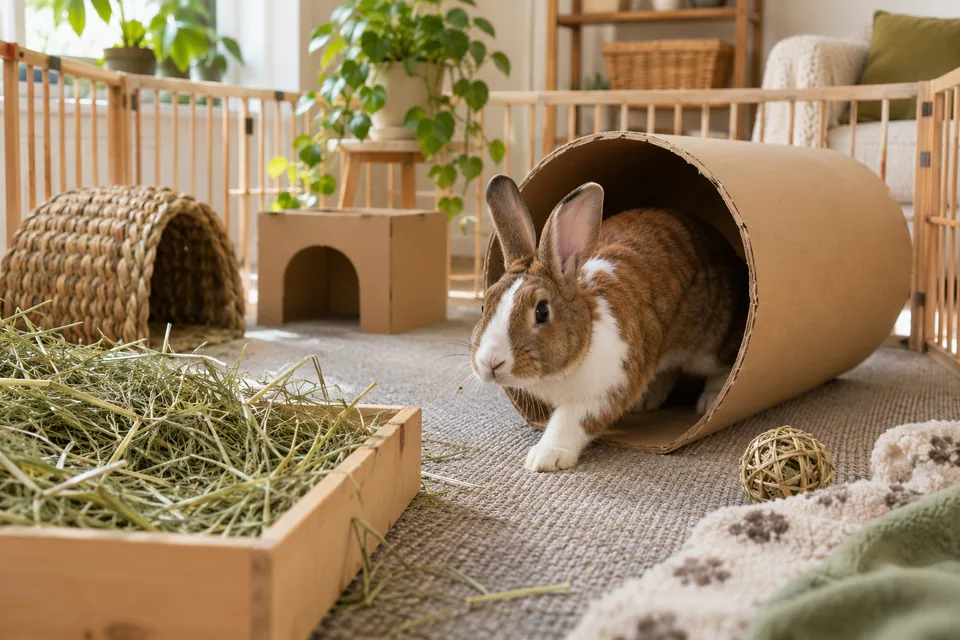
Rabbit enrichment should allow safe foraging, chewing, hiding and movement within a suitable living environment. Start with constant access to appropriate hay, secure space and simple supervised activities. Inspect materials and stop activities that encourage unsafe ingestion or distress.
In this guide
General care and training information. This article has not been reviewed by a veterinarian and does not replace an individual veterinary or behaviour assessment.
A rabbit does not need a room full of novelty toys to have an interesting afternoon. They need a suitable environment and opportunities to do rabbit things: explore, forage, chew, hide and move comfortably. The activity should fit the rabbit, rather than requiring the rabbit to tolerate an elaborate setup.
Start with housing, diet and veterinary care. Enrichment adds choices to a suitable life; it does not compensate for confinement, isolation or a diet that needs professional review.
Make the space safe before making it interesting
Rabbit-proof the area at floor level. Protect electrical cables, exclude household chemicals and unsafe plants, and block gaps where the rabbit could become trapped. Use secure boundaries and suitable non-slip footing. Keep the area away from predators and prevent unsupervised access by cats and dogs.
Think about what happens when you leave the room. An activity that is safe while you watch may not be appropriate overnight. Agriculture Victoria’s rabbit-care guidance is a starting reference for housing, diet and welfare needs. Check local rules before keeping rabbits, since ownership restrictions vary by location.
Build enrichment around the normal diet
Keep appropriate fresh hay available, and ask a rabbit-experienced veterinarian about the diet for your rabbit’s age and health. Use suitable parts of that normal diet in foraging rather than adding a stream of unfamiliar treats.
Place small amounts of familiar food in easy-to-find positions among safe hay or within a simple open cardboard arrangement. Keep clean feeding areas and observe what is eaten. Food games should not make access to essential food difficult, especially for a rabbit with health or mobility problems.
Four simple activities to introduce separately
A broad cardboard tunnel
Choose plain, safe cardboard without staples, adhesive tape or loose plastic. Provide openings large enough for easy movement and more than one exit. Watch the first sessions and remove damaged or ingested material. A tunnel should offer a route and a choice, not become a tight trap.
An easy hay search
Offer hay in more than one suitable clean place, or tuck a familiar food item loosely among it. Start with an obvious find. If the rabbit has to struggle, abandon the setup rather than making meals a frustration exercise.
A safe place to dig
Ask your veterinary team about suitable materials, then offer a stable container with an easy entrance and a safe, supervised digging option. Avoid dusty, sharp, scented or easily swallowed materials. Stop if the rabbit is ingesting the setup or seems distressed.
A changing route through familiar space
Move one safe obstacle or hiding box while preserving familiar resting areas and clear routes. Observe whether the rabbit explores voluntarily. Constantly rearranging the whole enclosure can remove predictability instead of adding useful choice.
RSPCA Australia’s enrichment overview discusses opportunities for foraging, movement and species-appropriate behaviour. Match ideas to your rabbit rather than treating a list as a daily target.
Inspect the activity after use
| Check | Why it matters in practice |
|---|---|
| Chewed edges and loose parts | A previously sound item may now have sharp or swallowable pieces |
| Width of openings | The rabbit needs an easy route through and out |
| Food and hay condition | Wet or soiled material needs replacement |
| Stability | A leaning box or tunnel should not collapse onto the rabbit |
| The rabbit’s choice | Ignoring or avoiding an item is a reason to simplify it |
Keep a small rotation of suitable activities and store the rest safely. You are looking for voluntary engagement and normal behaviour afterwards, not the most dramatic photograph.
Social needs and handling still matter
Rabbits have social needs that toys cannot replace. Discuss suitable companionship, neutering and careful bonding with an experienced rescue or rabbit-experienced veterinary team. Do not put unfamiliar rabbits together without an appropriate introduction plan.
Spend time at floor level and let the rabbit approach where possible. Avoid repeated lifting for an activity or photo. Children need active supervision and guidance; a rabbit’s wish to retreat should be respected.
Changes that need prompt veterinary advice
A rabbit eating less, producing fewer droppings, appearing hunched or becoming unusually quiet needs prompt advice from a rabbit-experienced veterinarian. If the rabbit stops eating or passing droppings, seek urgent care rather than waiting for a more appealing toy to solve it. Do not attempt a home treatment based on this article.
Keep a simple record of ordinary activity and food intake, along with the enclosure changes you make. The same habit of observing small details can also enrich your pet memory journal, without turning a health record into a substitute for professional care.
Frequently asked questions
What is the simplest rabbit enrichment activity?
Begin with safe opportunities to forage through appropriate hay and explore a familiar, rabbit-proof space. Make any additional activity easy and supervised at first.
Are cardboard toys safe for every rabbit?
No. Materials and chewing habits matter. Remove staples, tape and plastic, supervise use and stop if the rabbit ingests material or the item becomes unsafe.
Do rabbits need exercise wheels?
Do not use a wheel as a substitute for appropriate space and natural movement. Discuss suitable exercise and housing with a rabbit-experienced professional.
Can a dog keep my rabbit company?
A dog does not replace suitable rabbit companionship. Prevent unsafe contact and discuss social needs and bonding with an experienced rescue or veterinary team.
What if my rabbit stops eating during a new activity?
Remove the activity and seek prompt veterinary advice. Stopping eating or producing droppings requires urgent attention, not more training or treats.
Sources
Care principles were checked against these resources on 14 November 2026. The organisations listed have not reviewed or endorsed this article.