
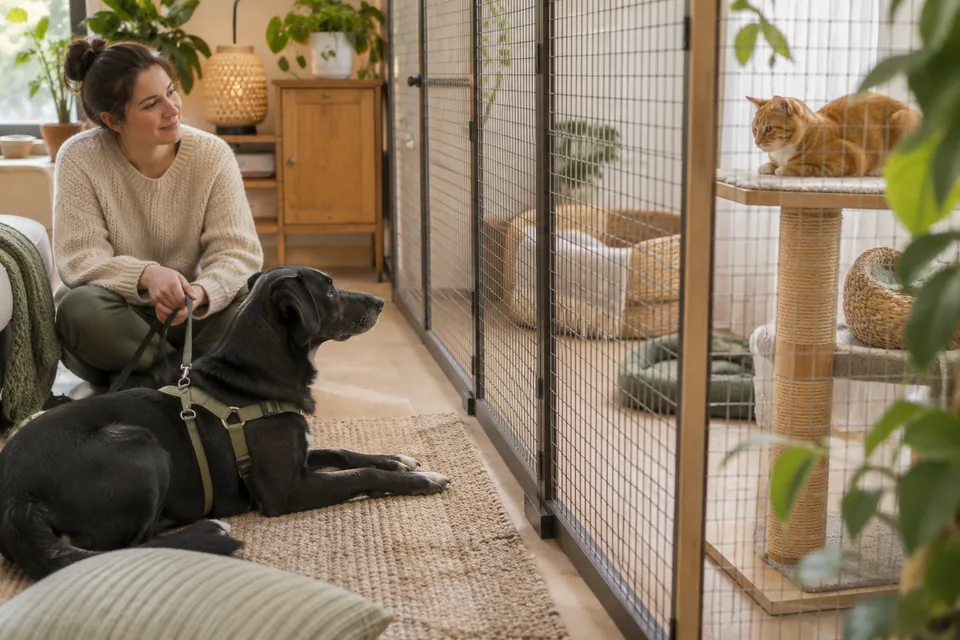
Introduce a cat and dog gradually: prepare separate safe spaces, allow indirect scent familiarity, then use a secure barrier and generous distance for short supervised sessions. Prevent chasing and let the cat retreat. Some pairings need professional help and may not be safe together.
In this guide
- Decide whether this pairing needs professional support first
- Prepare a complete cat-only base
- Begin without direct contact
- Use the first visual session to practise disengagement
- Read the whole pattern, not one signal
- Progress one variable at a time
- Write a household introduction plan
- Frequently asked questions
General care and training information. This article has not been reviewed by a veterinarian and does not replace an individual veterinary or behaviour assessment.
The first meeting does not need a photograph. It needs an exit plan. A cat who can retreat and a dog who can disengage are in a better position to learn about one another than two animals placed together to see what happens.
Think in stages rather than days. Progress depends on both animals’ behaviour, history and welfare. A calm first glance does not establish that they can be left together unsupervised.
Decide whether this pairing needs professional support first
Ask about each animal’s history before bringing them into shared space. A dog who has chased, grabbed or injured cats or other small animals needs an individual assessment from a qualified behaviour professional. A frightened or medically vulnerable cat may also need a different plan.
Do not use your cat to test whether a dog has a chase response. If safe separation cannot be maintained in your home, arrange support before the introduction. Peaceful coexistence is a reasonable goal; friendship cannot be promised.
Prepare a complete cat-only base
Set up a room with food, water, litter, resting places, scratching and hiding options before the new arrival. The dog must not be able to rush through the door. Plan household routines for opening doors, receiving deliveries and moving between rooms.
Check barriers from both animals’ perspectives. A low gate may be easy to jump, and gaps can allow a small animal through. A secure closed door is the starting separation; a later viewing barrier must genuinely contain both animals. Battersea’s introduction guide supports a gradual process with protected spaces.
Begin without direct contact
Let both animals settle into their own areas. Familiarise them with household sounds and, when they are comfortable, allow gentle indirect scent exchange using bedding or cloths they have chosen to rest on. Keep the item at a distance; do not hold it against either animal’s face.
Observe what happens afterwards. Sniffing and walking away is different from prolonged fixation, hiding or refusing to settle. If the new scent changes normal eating, resting or toileting, return to a simpler setup and ask for advice. There is no benefit in progressing because a calendar says it is time.
Use the first visual session to practise disengagement
For an appropriate pairing, start with a secure barrier, generous distance and another adult to help. Keep the dog on a comfortable harness and loose lead as an additional safeguard. The cat needs the option to stay away or use a raised retreat.
Reward the dog for calm attention to you and for turning away from the cat. Do not require a prolonged stare or an immediate approach. End while the animals are still comfortable. Cats Protection’s guidance emphasises gradual introductions and control over encounters.
Read the whole pattern, not one signal
| More manageable session | Reason to increase separation or stop |
|---|---|
| Animals can look away and return to normal activity | Fixed staring or repeated attempts to chase |
| Dog responds to familiar cues at that distance | Dog cannot disengage or is lunging |
| Cat chooses to observe and can retreat | Cat is cornered, frozen, hiding persistently or striking |
| Both settle after the session | Ongoing distress, disrupted eating or toileting |
A still animal is not necessarily a relaxed animal. If you are unsure what you are seeing, stop and seek qualified support. Never reach between animals during a conflict or rely on holding the cat in your arms.
Progress one variable at a time
When repeated sessions remain comfortable, a professional or experienced caregiver may guide a gradual reduction in distance or an increase in session length. Do not change both at once. Keep the dog from practising chasing, even if someone describes it as play.
Maintain cat-only escape routes and protected resources after apparent progress. Separate the animals when you cannot supervise and whenever either needs a break. Some households need permanent management; others may need to reconsider whether the pairing is suitable.
Write a household introduction plan
Before the next session, agree who holds the dog’s lead, who watches the cat, how to end calmly and which doors stay closed. Put a reminder near the door for visitors. Record distance and behaviour rather than describing a meeting only as good or bad.
Practise reward-based recall and loose-lead skills away from the cat. Those skills support management, but they do not replace a safe barrier or a careful assessment.
Frequently asked questions
How long does introducing a cat to a dog take?
There is no reliable fixed timetable. Progress only when both animals remain comfortable at the current stage, and seek help when either is struggling.
Should I let them work it out?
No. Prevent chasing and conflict with planned separation, barriers and supervised gradual introductions.
Can I put the cat in a carrier for the first meeting?
Avoid using a carrier to force proximity. The cat needs control over retreat rather than being trapped while the dog approaches.
Does a wagging tail mean the dog is safe with the cat?
No single signal proves safety. Look at fixation, body tension, ability to disengage and the whole interaction, with professional guidance where needed.
Can all cats and dogs learn to live together?
No. History, behaviour, welfare and the home layout matter. Some pairings cannot be managed safely or comfortably.
Sources
Care principles were checked against these resources on 14 November 2026. The organisations listed have not reviewed or endorsed this article.