
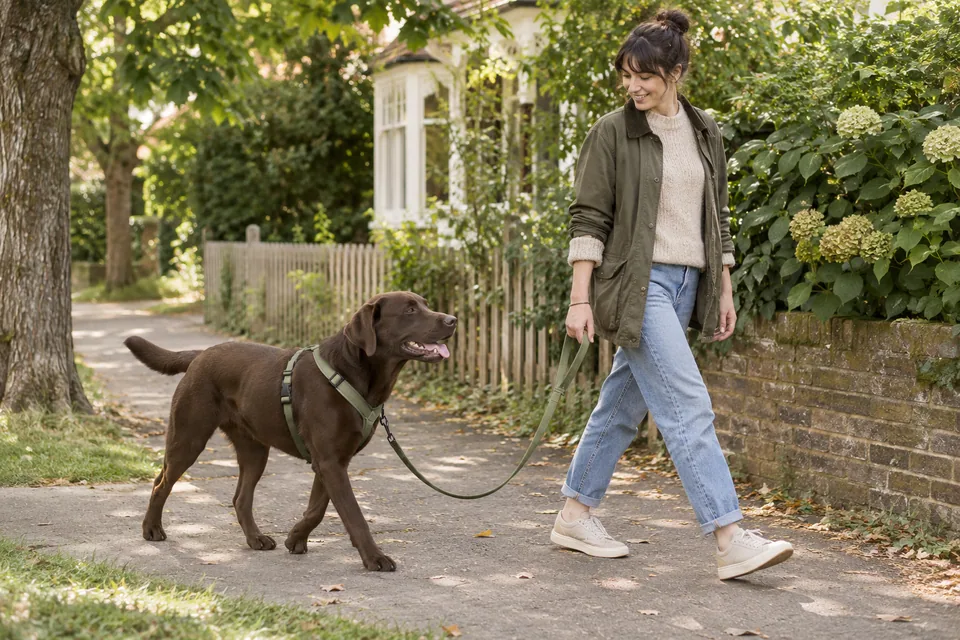
Teach loose-lead walking by rewarding your dog when the lead is slack, starting somewhere quiet and increasing difficulty gradually. If tension builds, pause or create space, then resume when the dog can move with you comfortably. Avoid lead jerks or equipment that causes pain.
In this guide
- Check comfort before asking for better walking
- Define the behaviour you will reward
- Build a short sequence before adding the street
- What to do when the lead tightens
- Let sniffing have a place in the walk
- A troubleshooting guide for ordinary walks
- Keep practice humane and realistic
- Frequently asked questions
General care and training information. This article has not been reviewed by a veterinarian and does not replace an individual veterinary or behaviour assessment.
A relaxed walk does not require a dog to stare at your knee. Loose-lead walking means you can travel together without continuous tension while still making room for sniffing, toilet breaks and the world outside the front door.
Begin by separating practice from the need to reach a destination. The first successful session might cover the length of a quiet hallway. That is a useful foundation, even if the eventual goal is a longer neighbourhood walk.
Check comfort before asking for better walking
Use well-fitting, comfortable equipment and a lead suitable for the setting. A harness should allow normal movement and be fitted securely. Avoid choke, prong or shock devices and do not jerk the lead to correct pulling. If walking suddenly changes or the dog appears uncomfortable, seek veterinary advice.
Choose a quiet starting area with non-slip footing and enough room to turn. Have suitable rewards ready before you clip on the lead. The RSPCA’s walking guidance centres on reinforcing a loose lead and preventing pulling from being the route to what the dog wants.
Define the behaviour you will reward
Decide which side is easiest for you, then reward the dog for being near you with a slack lead. Take one or two steps, mark the useful moment with a consistent word such as yes, and give the reward close to that position.
At first, reward often enough that the dog has a clear reason to stay connected. If you wait for a long stretch of perfect walking before offering anything, the interesting smell ahead may become the only obvious reward. Keep your hand relaxed and avoid using a visible treat as a permanent lure.
Build a short sequence before adding the street
Practise a few steps, a pause and a gentle change of direction. Let the dog notice your movement instead of pulling them around. Finish with an easy success, then allow a break.
When that pattern is comfortable, move to a slightly more interesting place. Dogs Trust’s first-walk advice supports short, positive practice and gradually rewarding attention and a loose lead. A front garden may be a meaningful increase in difficulty compared with the living room.
What to do when the lead tightens
If the dog pulls towards something and it is safe to pause, stop moving forward. Invite a return to a manageable position without hauling them back. Resume before frustration builds, rewarding slack and useful attention.
If a dog, cyclist or other trigger is too close, prioritise distance and safety instead of insisting on a training repetition. Move away calmly when you can. A dog barking or lunging repeatedly needs a plan for that behaviour, not a longer session of stopping and starting on a crowded pavement.
Let sniffing have a place in the walk
Reaching a safe sniffing spot can be part of the reward. Walk a short stretch together, then use a consistent release phrase and let the dog explore within safe lead length. There is no need to remove every interesting part of a walk in order to teach cooperation.
Keep the rules understandable. If pulling works for most of a hurried weekday walk, a weekend training session has to compete with that history. Shorter routes with planned sniffing pauses may be more achievable than a strict distance target.
A troubleshooting guide for ordinary walks
| Difficulty | A practical adjustment |
|---|---|
| Pulling begins at the front door | Practise clipping on, pausing and taking a few calm steps indoors |
| Dog manages indoors but not outside | Lower distraction and reward more frequently |
| Dog surges towards every smell | Build planned sniffing breaks into the route |
| Dog ignores food near other dogs | Increase distance and seek help if reactivity persists |
| Handler is physically struggling | Choose safer management and qualified support before continuing |
Change one element at a time so you can tell what helped. A brief note about the route, distance from distractions and moments of slack is more useful than labelling an entire outing a failure.
Keep practice humane and realistic
End before either of you becomes overwhelmed. Different family members should use compatible cues and reward the same basic behaviour. For a puppy, ask your veterinarian about safe outings before vaccination protection is complete, and do not turn a toilet break into an endurance exercise.
Practise coming when called separately and add simple enrichment to quieter days. Training supports daily life; it does not replace opportunities to rest, explore or receive appropriate care.
Frequently asked questions
Is loose-lead walking the same as heel?
No. A formal heel is a more precise position. Everyday loose-lead walking allows flexibility as long as continuous pulling is not required.
Should I stop every time my dog pulls?
A calm pause can help in a safe setting. When the dog is frightened, reactive or too close to a hazard, create safety and distance rather than insisting on a repetition.
Can a harness make my dog pull?
Equipment alone does not teach the walking skill. Use comfortable, well-fitting equipment alongside consistent rewards and manageable practice.
How long should a training walk be?
Keep practice brief enough that the dog and handler can succeed. Separate a small training session from the expectation to complete a long route.
When should I get a trainer involved?
Seek a qualified reward-based trainer if pulling is unsafe, progress stalls or the dog repeatedly barks, lunges, freezes or struggles around distractions.
Sources
Care principles were checked against these resources on 14 November 2026. The organisations listed have not reviewed or endorsed this article.