
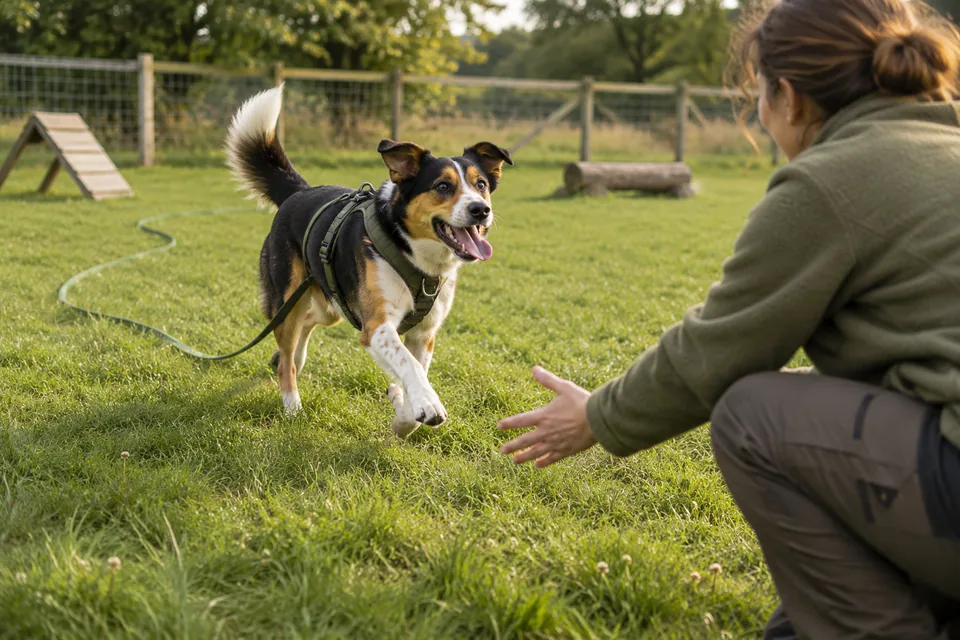
Build recall by pairing one clear cue with returning to you and a reward your dog values. Start close in a quiet secure area, then add distance and distractions gradually. Use safe lead management while learning; a successful practice does not guarantee recall around every hazard.
In this guide
General care and training information. This article has not been reviewed by a veterinarian and does not replace an individual veterinary or behaviour assessment.
A recall cue asks a dog to leave something interesting and choose you. The strongest reason to return should be the history of good things that happen when they do, not the possibility of being shouted at if they take too long.
Treat recall as a skill that needs both practice and management. Roads, wildlife, livestock, unfamiliar dogs and local restrictions still matter. A dog returning reliably in the kitchen has not demonstrated that they can safely run free elsewhere.
Agree on one cue and a useful reward
Choose a short word or whistle that everyone in the household can use consistently. Avoid turning it into background noise. Prepare small, suitable rewards the dog actually enjoys; food, a favourite game or another appropriate reward may work differently in different settings.
Practise when the dog can hear and notice you. Sudden difficulty responding, especially alongside other changes, deserves veterinary attention. A dog cannot learn from a signal they cannot comfortably perceive.
Start close enough to make returning easy
In a quiet secure area, get the dog’s attention, use the cue once and make yourself inviting. Move a step away if appropriate. Reward when the dog reaches you, rather than stopping them at arm’s length.
After rewarding, sometimes release the dog to resume a safe activity. If coming back always ends the fun, the cue may begin to predict a loss. Dogs Trust’s recall guide describes starting in a low-distraction environment and making return worthwhile.
Practise the arrival as well as the run
A dog racing towards you but darting away from the lead is not yet giving you a complete everyday recall. Separately practise comfortable handling near the harness or collar, brief lead attachment and release, using rewards and avoiding grabbing.
Do this at close range first. The point is not to trick the dog into being caught. It is to make arrival, a calm pause and the next step predictable. Stop and seek help if touching the equipment causes fear or signs of pain.
Use a long line as a safety tool
In an appropriate open area, a long training line attached to a well-fitting harness can provide more movement while you maintain management. Learn to handle it safely: prevent tangles, avoid wrapping it around fingers and do not let a running dog hit the end at speed.
Choose space away from roads, cyclists and other animals. Gloves and suitable instruction may help, but they do not make a crowded area appropriate. Battersea’s recall advice is a useful companion to a reward-based practice plan.
Increase one challenge at a time
| Variable | An easier version | A later progression |
|---|---|---|
| Distance | A few steps indoors | More space in a secure area |
| Distraction | Quiet room | Mild activity well away from the dog |
| Duration away | Brief exploration | A slightly longer safe sniff |
| Location | Familiar environment | A new but manageable place |
This is a progression tool, not a certificate for off-lead access. If the dog cannot respond at the new level, reduce the challenge. Practice should build useful repetitions rather than repeatedly confirm that the environment is more compelling than your cue.
What to do when your dog does not return
Stay calm. Do not repeat the cue continuously or punish the dog when they eventually arrive. Use safe management to prevent access to danger, and recover the dog without turning the situation into a chase game.
Review what made the request too difficult. Were you too far away? Was another animal moving nearby? Had every recent recall ended the walk? Return to easier practice and seek qualified support if running off persists. A dog with a strong chase history may need long-term lead management.
Keep the environment part of the decision
Check local access rules, lead requirements and wildlife protections before any outing. Even good training does not override them. Keep identification details current and choose secure places where practical. Do not use electronic punishment to force a response.
Our loose-lead walking guide helps make the managed parts of a walk more comfortable. Add sniffing and search games so interesting outdoor experiences are not limited to running far away from you.
Frequently asked questions
How do I teach recall to a dog who ignores me?
Start in a quieter place and at a shorter distance with a worthwhile reward. Check that the dog can comfortably notice you before increasing difficulty.
Should I keep repeating come?
Avoid repeating the cue continuously. If the dog cannot respond, use safe management and make the next practice easier.
Can I let my dog off the lead after a few successful sessions?
A few successes do not establish reliability around hazards. Consider the setting, local rules, distraction level and professional guidance, and maintain safe management.
Should I reward a dog who took a long time to return?
Do not punish the eventual return. Make being back with you a positive event, then review why the original request was too difficult.
Is a long line suitable everywhere?
No. Avoid places where it could tangle with people, animals, vehicles or obstacles. Learn safe handling and attach it to appropriate comfortable equipment.
Sources
Care principles were checked against these resources on 14 November 2026. The organisations listed have not reviewed or endorsed this article.